The Quantum Shortcut: How an Irish Startup Plans to Make Quantum Computing Actually Work
Equal1 just raised $60 million to build quantum computers using the same silicon manufacturing that makes your smartphone's chips. Their approach could solve quantum computing's biggest problem: nobody can actually use the things. Here's why this matters.
The Quantum Shortcut: How an Irish Startup Plans to Make Quantum Computing Actually Work
Equal1's silicon-based approach could finally make quantum practical
Quantum computing has a deployment problem.
For all the breathless announcements about quantum supremacy and exponential speedups, almost no one actually uses quantum computers for real work. The machines that exist require exotic cooling systems, dedicated teams of physicists, and specialized facilities that cost tens of millions of dollars to build and operate.
An Irish startup called Equal1 thinks this is backwards. Instead of building quantum computers that require the world to adapt to them, they are building quantum computers that fit into the world as it already exists.
Today, Equal1 announced $60 million in new funding to prove they are right.
What Is Equal1's Approach to Quantum Computing?
Equal1 builds quantum processors using standard silicon semiconductor manufacturing — the same fabrication processes that produce the chips in smartphones and laptops. This approach differs fundamentally from companies like IBM and Google, which use exotic superconducting systems requiring dilution refrigerators and specialized infrastructure.
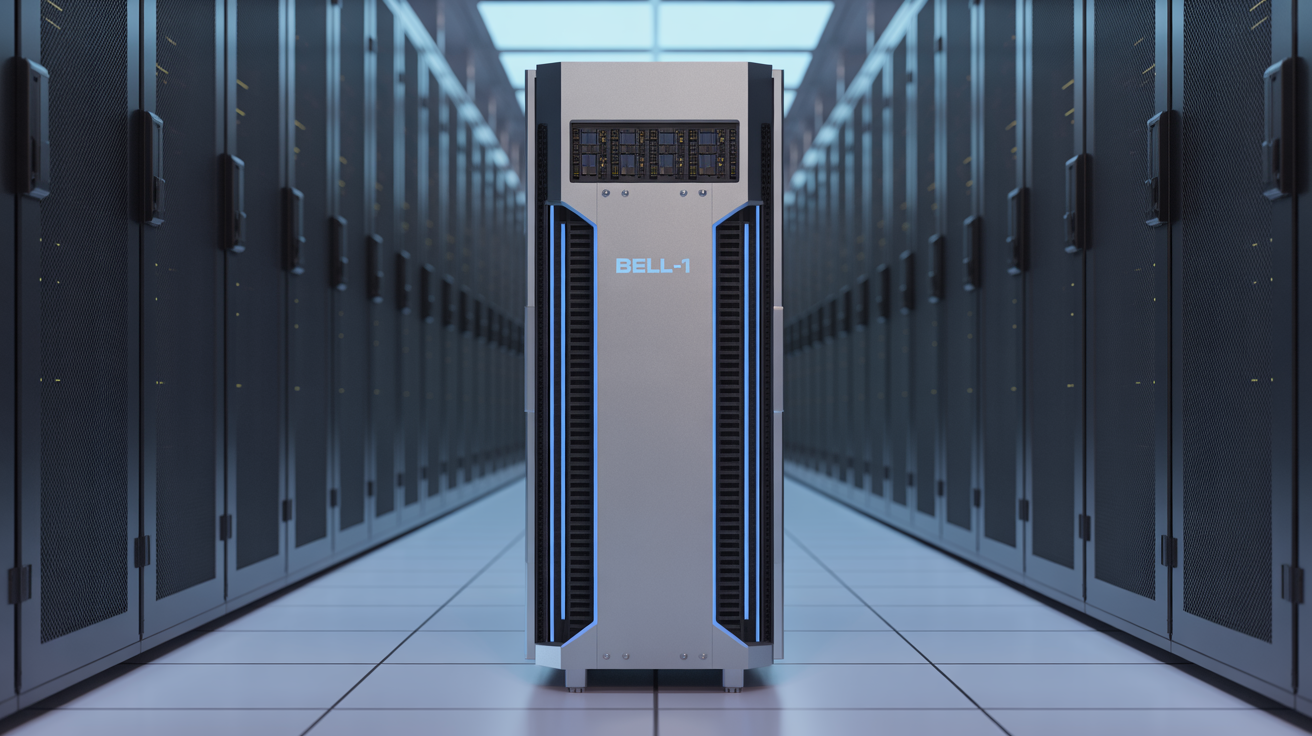
The result is the Bell-1: a quantum server that fits in a standard data center rack, plugs into a normal electrical outlet, and uses about as much power as a high-end GPU server.
Why This Matters
Most quantum computers look like science experiments because they are science experiments. IBM's quantum systems require cooling to temperatures colder than outer space. Google's Willow chip operates in heavily shielded facilities with support infrastructure that dwarfs the quantum processor itself.
Equal1's Bell-1 looks like a server because it is a server. It sits in a standard 600mm x 1000mm x 1600mm rack, weighs about 200 kilograms, and consumes 1,600 watts — roughly equivalent to running a high-performance gaming PC.
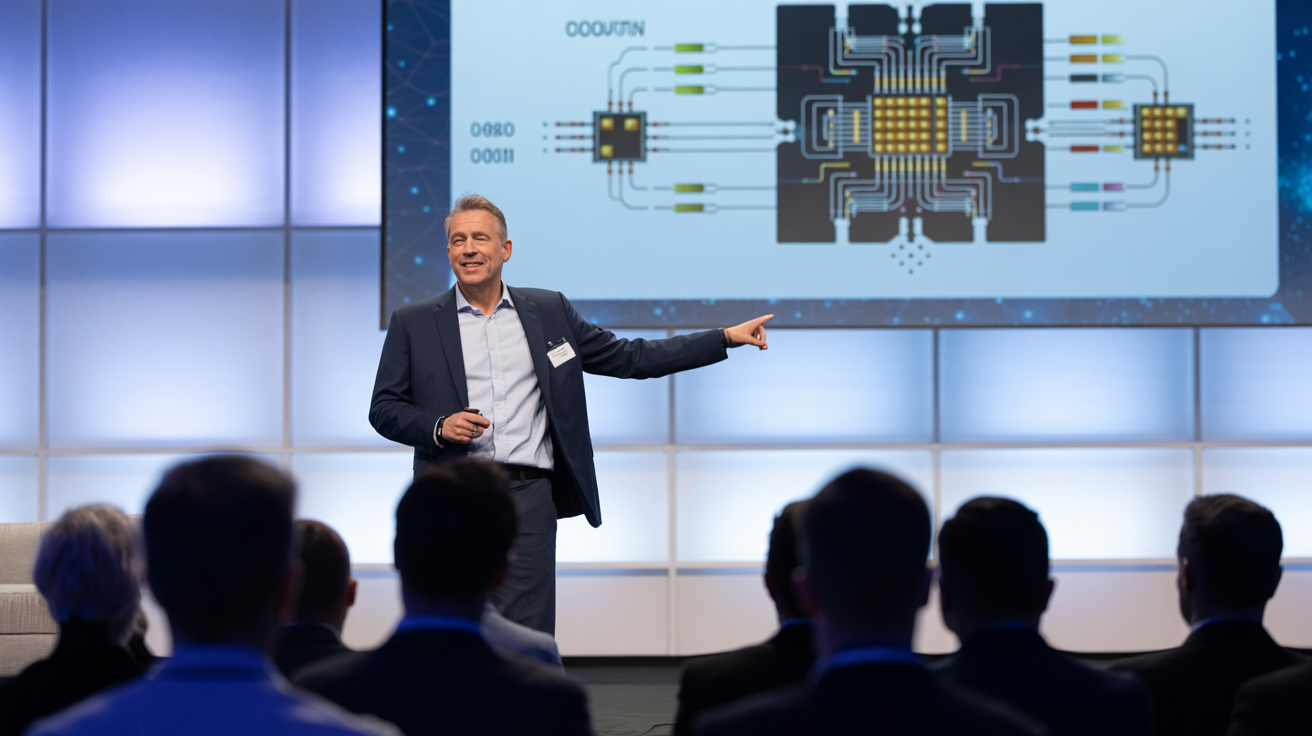
Comparison: Traditional vs. Silicon-Based Quantum Computing
| Factor | Traditional Quantum Systems | Equal1 Bell-1 |
|---|---|---|
| Cooling | Dilution refrigerators, near absolute zero | Self-contained cryo-cooler at 0.3K |
| Power consumption | Facility-level infrastructure | 1,600W (standard outlet) |
| Physical footprint | Dedicated rooms/buildings | Standard server rack |
| Operating staff | Teams of PhD physicists | Data center technicians |
| Cost | $10-50+ million | ~€2 million |
| Deployment location | Specialized facilities | Any data center |
How Does the Bell-1 Actually Work?
The Bell-1 uses a 6-qubit quantum processing unit built on Equal1's UnityQ chip architecture. The qubits are silicon-spin qubits — quantum bits encoded in the spin states of electrons in silicon.
Performance Specifications
The current Bell-1 achieves:
- Single-qubit gate fidelity: 99.40%
- CZ (two-qubit) gate fidelity: 98.40%
- Readout fidelity: Exceeds 99.9%
These numbers matter because quantum computers are notoriously error-prone. Every quantum operation has some probability of producing wrong results. The higher the fidelity, the more useful calculations the system can perform before errors accumulate to the point of uselessness.
Six qubits is not many — classical computers can simulate six qubits trivially. But Equal1's strategy is not about raw qubit count. It is about proving that silicon-based quantum computing works at all, then scaling up using the same manufacturing economics that drove semiconductor progress for decades.
Why Does Silicon Manufacturing Matter for Quantum Computing?
The semiconductor industry has spent trillions of dollars optimizing silicon fabrication over seventy years. Every year, the processes get better. Yields improve. Costs fall. Volume production becomes possible.
Equal1 is betting that quantum computing can ride this wave rather than fighting against it.
The Manufacturing Advantage
Most quantum approaches require bespoke manufacturing processes developed specifically for quantum applications. This means:
- Small production volumes
- High per-unit costs
- Limited ability to iterate and improve
- Dependence on specialized suppliers
Silicon manufacturing offers the opposite:
- Massive production volumes possible
- Costs decline with scale
- Rapid iteration through established foundry partnerships
- Access to the world's most sophisticated supply chain
Jason Lynch, Equal1's CEO, frames the challenge bluntly: "The current barrier to quantum isn't physics — it's production." The science of quantum computing is largely solved. The engineering challenge is building quantum systems at scale, and that is a problem the semiconductor industry knows how to solve.
Who Is Funding This?
The $60 million round was led by the Ireland Strategic Investment Fund (ISIF), with participation from Atlantic Bridge, the European Innovation Council Fund, Matterwave Ventures, Enterprise Ireland, Elkstone, and TNO Ventures.
Total funding now exceeds $85 million, with the company expecting additional follow-on investment in coming months.
What the Money Is For
Equal1 will use the funding to:
- Deploy Bell-1 systems to leading high-performance computing centers globally
- Embed quantum capabilities into real-world workloads
- Advance the roadmap toward millions of on-chip qubits
- Scale manufacturing through existing foundry partnerships
- Grow the team
The company is already shipping Bell-1 systems, including to the European Space Agency's Space HPC Centre in Italy, where the technology will accelerate processing of Earth observation data for climate modeling and disaster monitoring.
What Are the Limitations?
Six qubits cannot solve problems that classical computers cannot. Equal1's current systems are proof-of-concept, not production tools for quantum-native applications.
The Scaling Challenge
The path from six qubits to millions of qubits is not straightforward. Key challenges include:
- Error correction: More qubits means more errors to manage
- Connectivity: Qubits must interact efficiently as systems scale
- Control electronics: Classical systems must control quantum operations without introducing noise
- Thermal management: Keeping larger systems at operating temperature
Equal1's advantage is that silicon manufacturing has solved analogous problems before. The same principles that enabled Moore's Law — miniaturization, integration, process improvement — theoretically apply to silicon-based quantum systems.
Whether theory translates to practice remains to be proven.
How Does Equal1 Compare to Google's Willow Chip?
Google's December 2025 Willow announcement demonstrated 105 qubits with improved error correction — a genuine scientific milestone. But Willow and Bell-1 represent fundamentally different approaches to quantum computing.
Approach Comparison:
| Dimension | Google Willow | Equal1 Bell-1 |
|---|---|---|
| Qubit technology | Superconducting transmon | Silicon spin |
| Qubit count | 105 | 6 |
| Deployment model | Research facility | Data center server |
| Manufacturing | Custom fabrication | Standard silicon foundry |
| Operating temperature | ~15 millikelvin | 0.3 Kelvin |
| Target use case | Research, breakthrough demos | HPC integration, production |
| Timeline to commercial scale | Unclear | 4-5 years (CEO estimate) |
Google optimizes for raw capability and scientific headlines. Equal1 optimizes for deployability and commercial viability. Both approaches may ultimately succeed — or quantum computing may require something neither company has yet imagined.
What Does McKinsey Say About the Market?
McKinsey estimates quantum computing could unlock $100 billion in value by 2035. The Quantum Insider projects the quantum hardware and software market reaching $5 billion by 2030, with bullish scenarios considerably higher.
These projections assume quantum computers become practical tools rather than laboratory curiosities. Equal1's bet is that practicality requires a fundamentally different approach to building quantum systems.
The Commercial Timeline
Lynch anticipates commercial impact from quantum computing within four to five years. The current period represents what he calls a "transition" in the industry — movement from pure research toward practical application.
Whether Equal1's silicon approach leads this transition or loses to alternative technologies will depend on execution over the next several years.
The Competitive Landscape
Equal1 is not alone in pursuing silicon-based quantum computing. Intel has invested heavily in silicon spin qubits. UK-based Quantum Motion, France's Quobly, and Australia's Diraq are all developing similar approaches.
But Equal1 claims a first-mover advantage in deployment. While competitors remain largely in research phases, Equal1 is shipping actual systems to actual customers. The Bell-1 exists as a product, not a roadmap.
European Quantum Investment Context
Equal1's funding is part of a broader surge in European quantum investment. In 2025 alone, European quantum startups raised approximately €330 million in disclosed funding:
- IQM Quantum Computers: €275 million
- Equal1: €51.5 million ($60 million)
- Phasecraft: €29 million
- QuiX Quantum: €15 million
- Orange Quantum Systems: €12 million
Europe is positioning itself as a serious player in quantum technology, with Equal1 representing the largest late-development round outside of Finland.
The Investment Implications
For investors considering quantum computing exposure, Equal1 represents a different thesis than companies pursuing raw qubit count.
The Bull Case
- Silicon manufacturing economics provide a credible path to scale
- Data center compatibility enables practical deployment
- First-mover advantage in deployable systems
- Strong institutional backing from ISIF and European investors
- Clear timeline to commercial relevance (4-5 years)
The Bear Case
- Six qubits is far from commercially relevant scale
- Competition from Intel and other silicon approaches
- Google/IBM may solve deployment challenges at higher qubit counts
- Quantum computing market may take longer to materialize than projected
- Technical challenges in scaling silicon qubits remain unproven
The Key Question
Equal1's CEO aspires to build "the Nvidia of quantum" — a company that provides the fundamental compute infrastructure for a new computing paradigm. Whether silicon-based quantum computing can scale to meet that ambition remains the central uncertainty.
But today's funding represents a significant vote of confidence that the approach is worth pursuing seriously. The $60 million will buy several years of development time to prove or disprove the thesis.
What Happens Next
Equal1 will spend 2026 deploying Bell-1 systems to more HPC centers, gathering performance data from real-world workloads, and developing the Bell-2 successor system. The company expects to announce Bell-2 within the next year.
The broader quantum computing industry will continue its race toward practical utility. Google, IBM, and others will pursue their superconducting approaches. New technologies like photonic quantum computing will compete for attention and investment.
For now, Equal1 represents something quantum computing has lacked: a product that can actually be deployed in the real world. Whether that advantage proves decisive will determine if silicon becomes the foundation of practical quantum computing — or if quantum's future lies elsewhere.
The $60 million bet that quantum can be built like everything else in tech is officially on the table.
Sources & References
- 1. The Quantum Insider - Equal1 Announces $60 Million Raise
- 2. EU-Startups - Irish quantum semiconductor startup Equal1 closes €51 million round
- 3. Equal1 Official - Bell-1 Product Specifications
- 4. ARM Newsroom - Pushing Quantum Computing Boundaries with Arm and Equal1
- 5. Data Center Dynamics - Equal1 Launches Silicon Quantum Server Bell-1
Disclaimer: This analysis is for informational purposes only and does not constitute investment advice. Markets and competitive dynamics can change rapidly in the technology sector. Taggart is not a licensed financial advisor and does not claim to provide professional financial guidance. Readers should conduct their own research and consult with qualified financial professionals before making investment decisions.

Taggart Buie
Writer, Analyst, and Researcher