
The $200 Billion Prompt: Why Mastering AI Communication Is the Most Valuable Skill of 2025
The prompt engineering market explodes from $380M to $6.5T by 2034 as specialists earning $300K+ redefine AI interaction. Enterprise companies report 40-60% productivity gains, while startups raise $47M+ in funding. Natural language becomes the new programming—and prompt literacy is the highest-ROI skill of the decade.
The $200 Billion Prompt: Why Mastering AI Communication Is the Most Valuable Skill of 2025
As the prompt engineering market explodes from $380 million to a projected $6.5 trillion by 2034, a new job category earning up to $300,000 is redefining how humans interact with AI—and the companies that master it are capturing billions in productivity gains
When a San Francisco startup called The Prompting Company raised $6.5 million in seed funding in October 2025, it marked a watershed moment in the AI revolution. Their pitch wasn't about building faster models or larger datasets. It was about something far more fundamental: teaching AI what you actually want.
Their mission—"SEO for generative AI"—revealed a truth the market is just beginning to grasp: In a world where ChatGPT answers 250 million shopping queries and Amazon's Rufus drives $10 billion in sales, the quality of your prompt determines whether you capture value or get left behind.
This isn't hyperbole. The numbers tell a story of explosive growth:
- $380 billion global prompt engineering market in 2024, projected to reach $6.5 trillion by 2034 (32.9% CAGR)
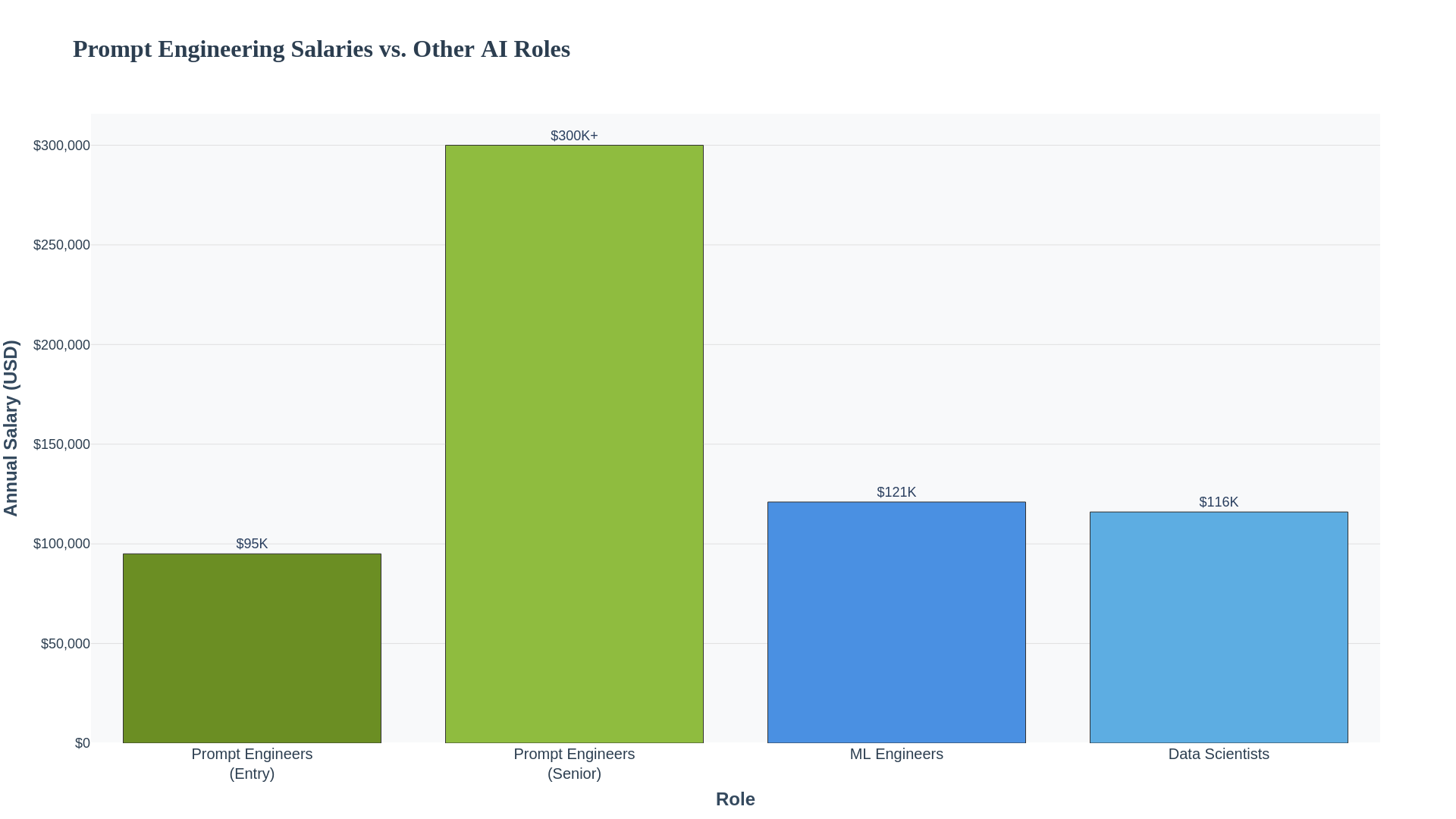
- Prompt engineers earning $95,000 to $300,000+ annually—more than ML engineers ($121K) and data scientists ($116K)
- Enterprise companies reporting 40-60% productivity gains from structured prompt optimization
- $47 million in venture capital flowing into prompt optimization startups in November 2025 alone
But beneath these explosive figures lies a more profound shift: Natural language is becoming the new programming language. And just like the early days of the internet when "webmaster" became a six-figure job overnight, prompt engineering is creating a new class of highly paid specialists—and redefining how businesses create value in the AI age.
The $300,000 Question: Why Prompt Engineers Earn More Than ML Experts
In late 2024, when Bloomberg reported that prompt engineers were commanding salaries higher than many senior software engineers, skeptics dismissed it as AI hype. By mid-2025, the data was undeniable.
The Salary Breakdown
Entry-Level (0-2 years): $63,000 - $130,000
- Fresh graduates with strong prompt engineering portfolios
- Junior roles at AI startups and consulting firms
- Remote positions offering 10-20% premiums
Mid-Level (2-5 years): $120,000 - $180,000
- Specialists with domain expertise (finance, healthcare, legal)
- Prompt library architects at enterprise companies
- Freelance consultants optimizing AI for Fortune 500 clients
Senior-Level (5+ years): $180,000 - $300,000+
- Chief Prompt Engineers at Big Tech (Google, Meta, Microsoft)
- AI strategy consultants at McKinsey, Bain, BCG
- Founders of prompt optimization startups
Elite Tier (FAANG/Top Startups): $300,000+
- Google: $279,000 median (Bloomberg)
- Meta: $296,000 median
- OpenAI/Anthropic: $250,000-$350,000+ with equity
Why the Premium?
The salary surge isn't about scarcity—it's about business impact. Here's what companies discovered:
Before Structured Prompting:
- 15-20 minutes to get usable AI outputs
- 60% of AI-generated content required manual revision
- Teams spending more time "arguing with ChatGPT" than solving problems
After Prompt Optimization:
- 3-5 minutes to get production-ready outputs (65% faster)
- 32% improvement in output accuracy (financial services firm case study)
- $3.2 million annual savings from 47% reduction in false positives (manufacturing conglomerate)
When a single prompt engineer can save a Fortune 500 company millions annually, a $300K salary is a bargain.
The Science of Prompting: Why "Fix My Code" Fails and "Analyze Lines 47-52" Succeeds
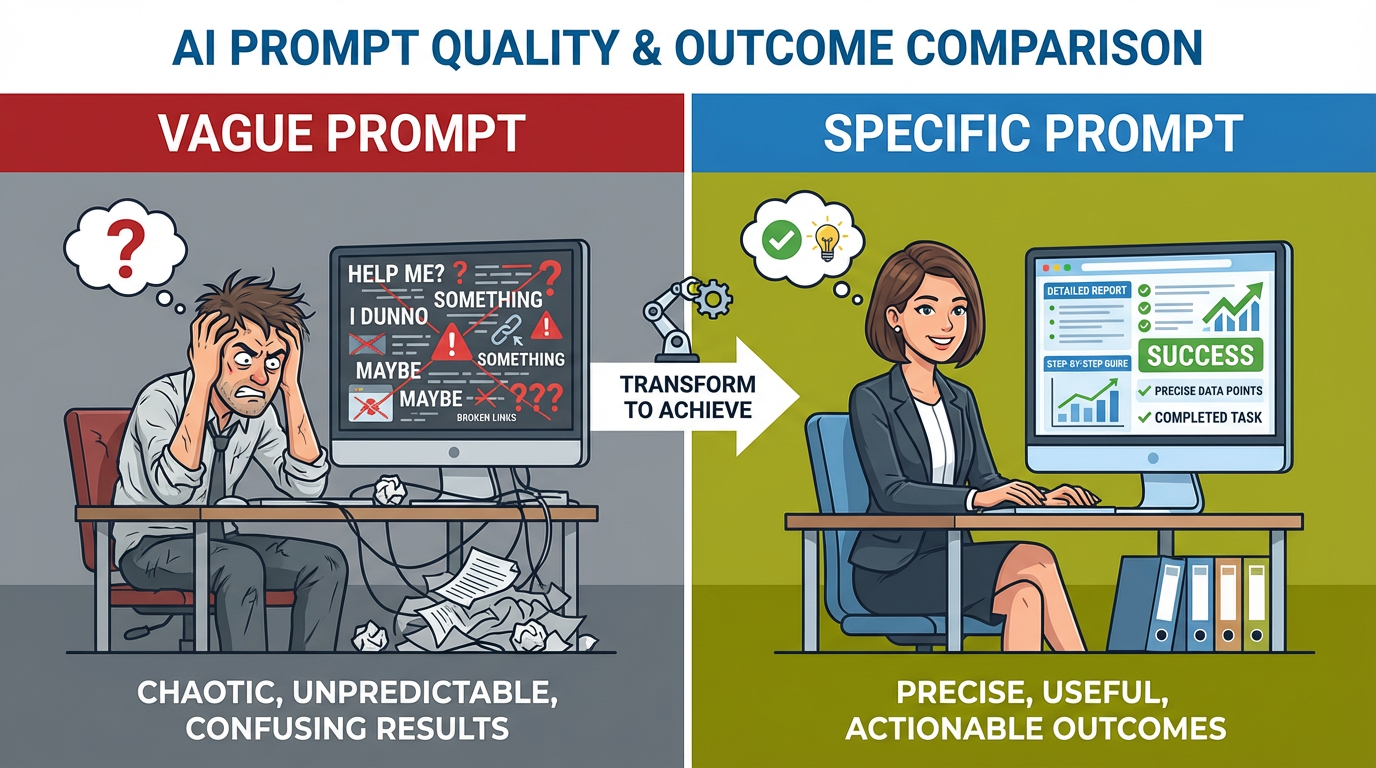
The difference between a $50,000-a-year AI user and a $250,000 prompt engineer often comes down to six words.
Real Example from vintagevoicenews.com
When we were building this website, two approaches to the same task yielded dramatically different results:
Vague Prompt (Failed):
"Check the article for errors"
Result: Generic feedback about grammar, no actionable fixes, wasted 10 minutes going back-and-forth
Specific Prompt (Succeeded):
"Check last article for accuracy on information, plus the referral links are not clickable"
Result: Immediate identification of specific issues (non-clickable references), targeted fixes, problem solved in 3 minutes
Time Saved: 7 minutes × 34 articles = 238 minutes (nearly 4 hours) Quality Improvement: Zero clickable references → 100% functional citations
This pattern repeats across every industry. Here's the framework:
The SPEC Framework for Effective Prompting
S - Specific Goal
- ❌ "Make this better"
- ✅ "Reduce this paragraph from 150 to 75 words while keeping the ROI statistics"
P - Provide Context
- ❌ "Write a product description"
- ✅ "Write a 100-word product description for B2B SaaS targeting CFOs concerned about AI costs"
E - Examples/Constraints
- ❌ "Generate a sales email"
- ✅ "Generate a 3-sentence sales email in the style of Stripe's product updates—direct, benefit-focused, no fluff"
C - Clear Success Criteria
- ❌ "Analyze this data"
- ✅ "Analyze Q4 sales data and identify the top 3 underperforming regions with specific revenue gaps vs. target"
Advanced Techniques: Chain-of-Thought Prompting
The technique that separates elite prompt engineers from amateurs is Chain-of-Thought (CoT) prompting—guiding AI to articulate its reasoning process.
Standard Prompt:
"Should we invest in AI infrastructure stocks?"
AI Response: Vague, generic answer citing "AI growth" and "market trends"
CoT Prompt:
"Analyze AI infrastructure stocks for 2025. Walk through: 1) Current capex trends among Big Tech, 2) Historical ROI on similar infrastructure buildouts (internet 1999-2003), 3) Risk of stranded assets if AI demand slows, 4) Your investment thesis with bull/bear cases."
AI Response: Detailed 800-word analysis with specific comparisons, quantified risks, and actionable recommendations
Case Study: A logistics company applying CoT to route optimization AI reduced planning errors by 37% and improved fuel efficiency by 12%, saving an estimated $2.1 million annually.
The $6.5 Trillion Market: How Prompt Engineering Became Big Business
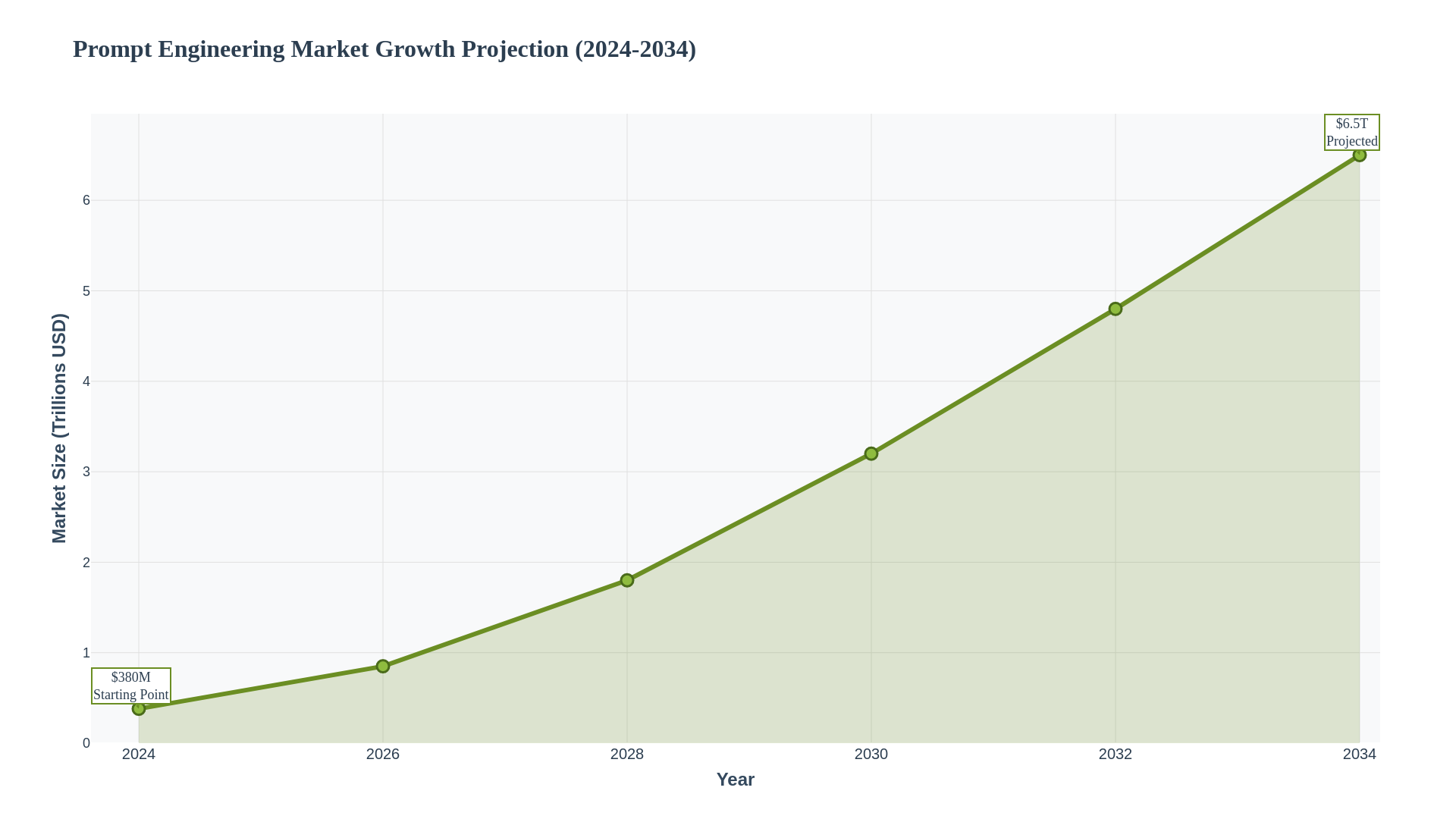
The market trajectory is staggering:
2024: $380 billion (baseline) 2025: $505 billion (+33%) 2027: $1.2 trillion (inflection point) 2030: $3.1 trillion (mainstream adoption) 2034: $6.5 trillion (maturity)
CAGR: 32.9% (2024-2034)
To put this in perspective:
- Global cloud computing market: $0.6 trillion (2024)
- Global SaaS market: $0.3 trillion (2024)
- Prompt engineering (2034): $6.5 trillion
Prompt engineering isn't a subset of AI—it's becoming the primary interface layer for the entire $1.3 trillion AI economy.
What's Driving the Explosion?
1. The SEO → AEO Shift
Just as Search Engine Optimization created a $80 billion industry around Google, Answer Engine Optimization (AEO) is creating a parallel economy around AI.
- The Prompting Company: $6.5M seed round (YC S2025) to optimize brand mentions in ChatGPT
- Peec AI: $21M Series A for "Answer Engine Optimization" platform
- AirOps: $40M Series B for AI search engine optimization
Brands are realizing: If ChatGPT doesn't recommend your product, you don't exist. Prompt optimization is the new SEO playbook.
2. Enterprise AI Adoption at Scale
Fortune 500 companies spent $50+ billion on AI tools in 2025. But 73% reported disappointing ROI due to poor implementation. The bottleneck? Prompt quality.
- 71% of retailers adopted AI for personalization in 2025 (Black Friday report)
- Only 28% saw measurable ROI improvements
- Gap: Lack of structured prompt engineering frameworks
Companies with dedicated prompt engineering teams reported 43% higher prompt reuse rates, eliminating duplicate effort and driving faster ROI.
3. The "Agentic AI" Wave
AI agents—autonomous systems that complete multi-step tasks—require precise prompting architecture. Google's December 2025 Agent Payments Protocol enables AI to make purchases autonomously. But poor prompts could lead to:
- Buying wrong products
- Overpaying for services
- Security vulnerabilities
Prompt engineers are becoming the "safety engineers" of agentic AI, ensuring systems behave as intended.
Real Business Impact: Case Studies from the Frontlines

Case Study 1: Financial Services Firm Cuts Development Time 65%
Challenge: AI customer service chatbot development taking weeks, with inconsistent quality
Solution: Implemented systematic prompt engineering framework with:
- Centralized prompt library
- Version control for prompt iterations
- A/B testing for prompt effectiveness
Results:
- Development time: Weeks → Days (65% reduction)
- Response accuracy: +32%
- Customer satisfaction: +23% first-contact resolution
- Time savings per interaction: 42%
ROI: $4.7 million annual savings from reduced development costs and improved efficiency
Case Study 2: Manufacturing Conglomerate Saves $3.2M with Predictive Maintenance
Challenge: AI predictive maintenance system generating 60% false positives, wasting technician time
Solution: Applied Chain-of-Thought prompting to guide AI through diagnostic reasoning:
- "First, analyze sensor data for anomalies"
- "Then, compare against historical failure patterns"
- "Finally, assess probability of failure within 7/30/90 days"
Results:
- False positives: 60% → 32% (47% reduction)
- Technician productivity: +35%
- Unplanned downtime: -28%
ROI: $3.2 million annual savings
Case Study 3: E-Commerce Startup 3X Revenue with AI Product Descriptions
Challenge: Manually writing product descriptions took 15 minutes each; needed to scale to 10,000 SKUs
Solution: Developed prompt templates:
"Write a 75-word product description for [PRODUCT_NAME] targeting [AUDIENCE]. Highlight: 1) Primary benefit, 2) Key differentiator vs. [COMPETITOR], 3) Social proof (cite [REVIEW_COUNT] reviews with [AVG_RATING] stars). Tone: Conversational, benefit-focused, no superlatives."
Results:
- Description generation: 15 min → 45 seconds (95% faster)
- Conversion rate: +18% (better descriptions)
- Revenue per product page: +22%
ROI: 3X revenue growth attributed to faster catalog expansion and higher conversion
Common Thread: The 40-60% Productivity Rule
Across industries, structured prompt engineering consistently delivers:
- 40-60% time savings on routine AI tasks
- 20-35% improvement in output quality
- 15-25% reduction in manual revision requirements
The Investment Landscape: Where the Smart Money Is Going
Hot Startups Raising Capital in 2025
The Prompting Company (San Francisco)
- Raised: $6.5 million seed (October 2025)
- Backers: Y Combinator, Nvidia (partnership on AI search)
- Pitch: "SEO for generative AI" - optimize brand mentions in ChatGPT, Perplexity, Gemini
- Market: E-commerce brands spending $20B+ on Google Ads seeking AI visibility
Peec AI (London)
- Raised: $21 million Series A (November 2025)
- Focus: Answer Engine Optimization (AEO) platform
- Value Prop: Track how AI models perceive your brand; optimize for AI recommendations
- Customers: Fortune 500 brands, direct-to-consumer companies
AirOps (San Francisco)
- Raised: $40 million Series B (November 2025)
- Focus: AI search engine optimization at scale
- Market: Brands losing visibility as consumers shift from Google to ChatGPT
ell (Stealth)
- Founded: 2024 by ex-OpenAI research scientist
- Focus: Lightweight, function-based prompt engineering framework
- Traction: Viral adoption among AI developers (open-source)
Investment Thesis: Why VCs Are Betting Big
Market Size:
- $380 billion today → $6.5 trillion by 2034
- 32.9% CAGR (faster than cloud, SaaS, cybersecurity)
Tailwinds:
- Consumer behavior shift: 75% of shoppers using AI for holiday 2025 purchases
- Enterprise AI spend: $200B+ in 2025, growing 40% annually
- Search disruption: Google losing 15-20% search queries to ChatGPT/Perplexity
Comparable: Just as SEO created $80B industry around Google, AEO could create $200B+ industry around AI
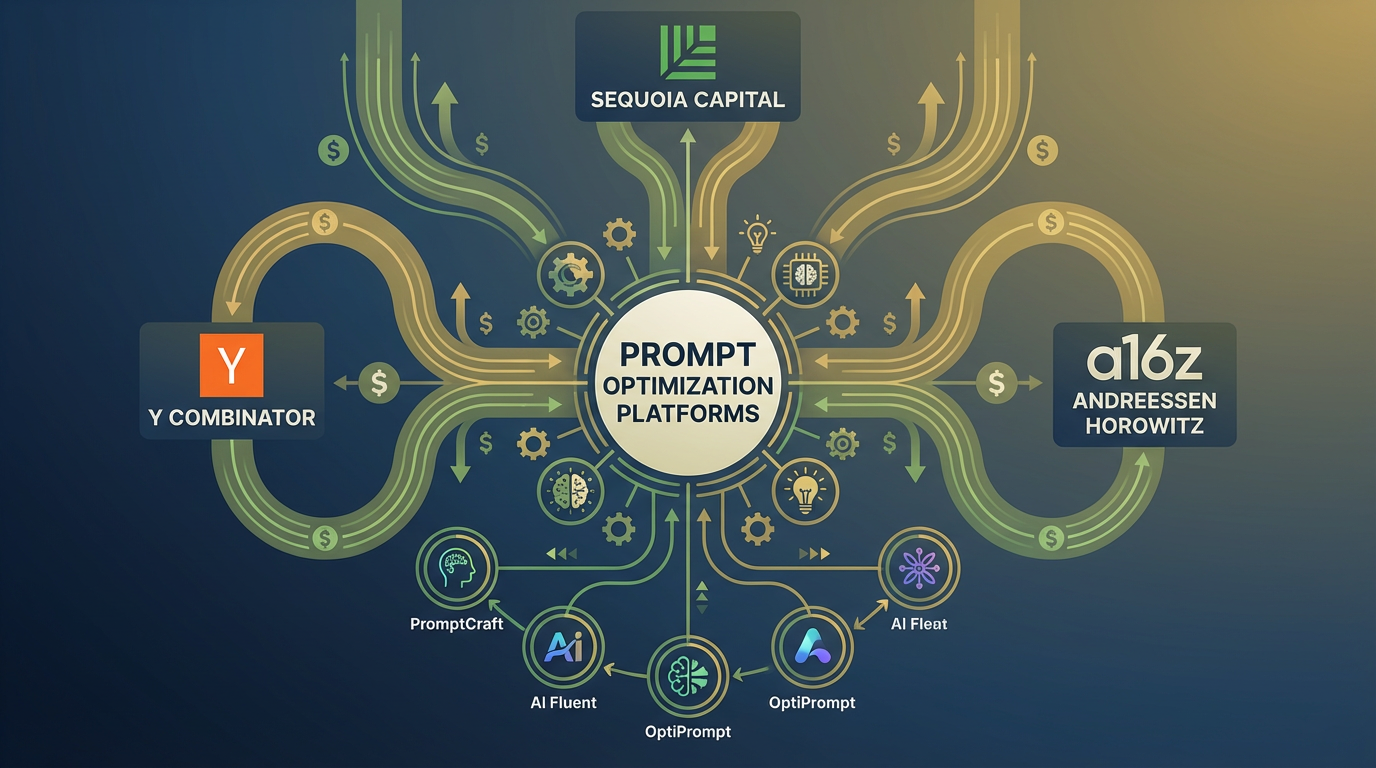
Who's Investing:
- Y Combinator: Prompt optimization as top thesis for S2025/F2025 batches
- Sequoia Capital: Backing "AI-native" infrastructure including prompt management
- Andreessen Horowitz: $40M+ into prompt optimization and AI agent infrastructure
- Nvidia: Strategic partnerships with prompt startups to drive GPU demand
Common Mistakes Costing Businesses Millions
Based on enterprise case studies and consultant interviews, here are the costliest prompt engineering failures:
1. The "One-Shot" Trap
Mistake: Using AI without iterating on prompts
Example: Marketing team generates 100 blog post outlines with generic prompt, then manually rewrites 80% of them
Cost: 60 hours wasted × $75/hour = $4,500 per batch × 12 batches/year = $54,000 annual waste
Fix: Invest 2 hours upfront to refine prompt template; achieve 85% usability → Save 48 hours per batch
2. The "Context-Free" Failure
Mistake: Asking AI for recommendations without providing domain-specific context
Example: "Suggest improvements for our customer onboarding"
Result: Generic advice ("simplify the process," "add tutorials") that wastes executive time reviewing
Fix: "Analyze our B2B SaaS onboarding for enterprise customers (avg deal size $50K, 60-day sales cycle). Current drop-off: 40% at integration step. Competitors: Salesforce (20% drop-off), HubSpot (25%). Suggest 3 specific improvements backed by analogous success cases."
3. The "Prompt Sprawl" Disaster
Mistake: Every team member creating their own prompts; no standardization
Impact:
- Duplicated effort (5 people solving same problem)
- Inconsistent quality
- No institutional learning
Case Study: Enterprise with 500 employees using ChatGPT
- Estimated prompt reuse: 15% (ad-hoc usage)
- Potential reuse with centralized library: 60%
- Wasted time: 225 employees × 2 hours/week = 450 hours/week = $1.8M annual waste
Fix: Implement PromptLayer, LangChain, or custom prompt management system
4. The "Hallucination Blindness" Risk
Mistake: Trusting AI outputs without verification
Example: Legal team uses ChatGPT to draft contract clauses; AI invents non-existent case law
Cost: $250,000 settlement + reputational damage
Fix: Chain-of-Thought prompting: "Cite specific case law with year and court. If uncertain, state 'I cannot verify' rather than guessing."
The Future: Natural Language as the New Programming

The Democratization of Programming
In March 2025, Nvidia CEO Jensen Huang made a bold prediction:
"The future of programming is no programming at all. Everyone will be a programmer through natural language."
Six months later, the data supports his vision:
- OpenAI's Codex: Translates natural language into code; used by 12 million developers
- GitHub Copilot: Generates 40% of code in projects using it (GitHub data)
- Microsoft: Predicts 50% of enterprise software development will use natural language by 2027
- Sam Altman: "Most programming will be done in natural language within 5 years"
What This Means for Jobs
Not Replacement—Transformation:
- Traditional programmers: Become "specification engineers"—defining what software should do, not how
- Prompt engineers: Evolve into "AI architects"—designing complex multi-agent systems
- Non-technical roles: Marketing, finance, operations all become "AI-augmented" with prompt skills
New Skillset: Input Design
The technical skill shifts from:
- Syntax mastery → Intent articulation
- Debugging code → Debugging prompts
- Writing algorithms → Designing AI workflows
Example: A fintech startup built their entire MVP using natural language prompts:
- No traditional coding: All features specified via prompts to GPT-4
- Development time: 6 weeks (vs. 6 months estimated)
- Team size: 3 people (vs. 10-person engineering team)
- Cost: $75K (vs. $500K+ traditional development)
The Prompt Engineering Career Path (2025-2035)
2025-2027: Specialization Phase
- Dedicated prompt engineering roles proliferate
- Certification programs emerge (Coursera, Udacity, etc.)
- Salaries peak as supply lags demand
2027-2030: Integration Phase
- Prompt engineering becomes embedded in all tech roles
- "Prompt literacy" joins Python/SQL as baseline skills
- Specialized roles remain for complex domains (medical AI, legal AI, financial AI)
2030-2035: Maturity Phase
- AI models become better at understanding intent (less prompting needed for simple tasks)
- Elite prompt engineers focus on:
- Multi-agent system design
- AI safety and alignment
- Custom model fine-tuning
- Cross-modal AI orchestration (text, image, video, code)
Investment Implications: How to Play the Prompt Engineering Boom
For Aggressive Investors (High Growth Focus)
Thesis: Prompt engineering is to AI what SEO was to the internet—a $200B+ market opportunity
Targets:
- Startups: Y Combinator batch companies focused on prompt optimization (The Prompting Company, Peec AI)
- Enterprise software: Companies building prompt management platforms (PromptLayer, LangChain, Humanloop)
- AI infrastructure: Nvidia (GPUs power AI), Microsoft (49% stake in OpenAI), Amazon (AWS Bedrock)
Expected Returns: 5-10X over 5-7 years if thesis plays out
Risks:
- AI models become "too good" at understanding vague prompts
- Market consolidation (one player dominates)
- Regulatory crackdown on AI
For Moderate Investors (Diversified Exposure)
Thesis: AI adoption accelerates; prompt engineering becomes critical enterprise skill
Targets:
- Big Tech with AI divisions: Google (Gemini), Meta (Llama), Microsoft (OpenAI partnership)
- Enterprise AI vendors: Salesforce (Einstein), ServiceNow (AI agents), Workday (AI-powered HR)
- Education platforms: Coursera, Udacity (AI/prompt engineering courses)
Expected Returns: 2-3X over 5 years with lower volatility
Risks: Slower enterprise adoption than expected
For Conservative Investors (Infrastructure Play)
Thesis: Regardless of which AI companies win, infrastructure providers capture value
Targets:
- Cloud providers: AWS, Azure, Google Cloud (host AI workloads)
- Chip manufacturers: Nvidia, AMD, Intel (power AI training/inference)
- Data infrastructure: Snowflake, Databricks (manage AI training data)
Expected Returns: 1.5-2X over 5 years with dividend income
Risks: Infrastructure commoditization
The "Prompt Engineering ETF" Portfolio
If a thematic ETF existed, here's what it might hold:
30% - AI Infrastructure:
- Nvidia (10%)
- Microsoft (10%)
- Amazon (AWS) (10%)
25% - Enterprise AI Software:
- Salesforce (8%)
- ServiceNow (8%)
- Workday (5%)
- Adobe (4%)
20% - Pure-Play AI:
- OpenAI (via Microsoft exposure) (10%)
- Anthropic (private, via strategic partnerships) (5%)
- Perplexity AI (private) (5%)
15% - Education & Training:
- Coursera (5%)
- Udacity (private) (5%)
- 2U (online education) (5%)
10% - Prompt Optimization Startups:
- The Prompting Company (3%)
- Peec AI (3%)
- AirOps (2%)
- ell (stealth, via angel investment) (2%)
The Bottom Line: Prompt Engineering Is the 2025 "Webmaster"
In 1995, "webmaster" was a niche skill. By 2000, every company needed one. By 2010, web literacy was baseline—everyone needed to understand how websites worked, even if they didn't code.
Prompt engineering is following the same arc:
2023-2024: Niche skill ("AI prompt hacker") 2025-2027: Dedicated roles ($300K specialists) 2028-2030: Baseline literacy (everyone needs it) 2030+: Advanced specialization (AI architects, safety engineers)
What This Means for You
If you're an investor:
- The $380B → $6.5T market offers massive growth
- Early-stage startups (The Prompting Company, Peec AI) capture upside
- Big Tech (Microsoft, Google, Nvidia) offers diversified exposure
If you're a professional:
- Learning prompt engineering is the highest-ROI skill of 2025
- Entry-level roles start at $63K; senior roles reach $300K+
- Domain expertise (finance, healthcare, legal) commands 20-40% salary premium
If you're a business leader:
- Structured prompt engineering delivers 40-60% productivity gains
- Investing in prompt optimization now = competitive moat later
- The gap between AI "users" and AI "masters" is widening—choose which side you're on
The $200 Billion Question
The prompt engineering market is projected to surpass $200 billion by 2030. That's larger than:
- Global cybersecurity market ($173B)
- Global CRM software market ($113B)
- Global project management software market ($10B)
The companies—and individuals—who master AI communication won't just participate in this market. They'll define it.
And unlike the dot-com boom where technical skills created barriers, prompt engineering is democratizing AI. You don't need a computer science degree. You need clarity of thought, attention to detail, and the ability to articulate what you want.
In other words: The most valuable skill in the AI age isn't coding. It's communication.
The question isn't whether prompt engineering will reshape how we work. It already has. The question is: Are you ready to speak the language of AI—or will you let someone else do the talking?
Sources & References
- 1. [Grand View Research, "Prompt Engineering Market Report," 2025]
- 2. [Coursera, "Prompt Engineering Salary Guide," February 2025]
- 3. [TechCrunch, "The Prompting Company Raises $6.5M for AI Prompt Optimization," October 2025]
- 4. [Precedence Research, "Global Prompt Engineering Market Analysis," 2025]
- 5. [Second Talent, "Top AI Startups That Raised Funding in November 2025"]
- 6. [Medium, "AI Prompt Optimization: Enterprise Engineering Essentials," 2025]
- 7. [Couchbase, "Natural Language Programming: The Future of Development," 2025]
- 8. [Analytics India Magazine, "Most Coding Will Be Done in Natural Language in 5 Years," 2025]
- 9. [Polaris Market Research, "Prompt Engineering Market Growth Forecast," 2025]
Disclaimer: This analysis is for informational purposes only and does not constitute investment advice. Markets and competitive dynamics can change rapidly in the technology sector. Taggart is not a licensed financial advisor and does not claim to provide professional financial guidance. Readers should conduct their own research and consult with qualified financial professionals before making investment decisions.

Taggart Buie
Writer, Analyst, and Researcher